SERVE Winery: The Yellow Building, the French Accent, and Romania’s Own Wine Voice
- Christopher 'Cp' Richardson

- May 6
- 9 min read
There are some wineries you remember because of the wine. Others because of the view. SERVE Winery gives you something to remember before you even step inside. You see the yellow building first. Not a soft yellow. Not a “we thought this would look nice in photos” yellow. This is a bright, confident yellow that announces itself from the road. Then you notice the matching yellow car parked outside, and suddenly it becomes clear that this was not an accident. There was an intention behind it.

During the visit, we learned that the building had become part of the winery’s identity. People in the area knew it as the winery with the yellow building, and even the kids in the neighborhood called it that. So, naturally, SERVE leaned into it. They got the car to match.
A winery can spend years trying to manufacture a memorable image, or it can simply listen when the neighborhood already gives it one.
That detail says a lot about SERVE before you hear a word about the wine. It is playful, self-aware, and comfortable enough in its own story to let the outside world shape part of the brand.
SERVE: A Winery with a French Accent in Romania

SERVE is memorable not only for its color. It sits in an important place in Romania’s wine story. The winery is known as the first private winery in Romania after the fall of the communist government, which gives the visit more weight. This was not just a vineyard tour. It was a reminder that Romanian wine has gone through its own rebuilding, reimagining, and reclaiming. That context matters because SERVE carries itself like a winery that understands both history and freedom. You can feel the Romanian foundation, but you can also clearly see the French influence running through the place.
The story of SERVE is not simply “Romanian wine made with French ideas.” It feels more nuanced than that. It is Romanian wine with a French accent, but it is not trying to become French wine. That distinction is important. The French influence came through in the way the team talked about technique, structure, and tradition. There was a clear respect for classic winemaking principles, but it never felt like the winery was copying someone else’s playbook. Instead, SERVE seems to take those ideas and apply them to Romanian land, Romanian grapes, and Romanian conditions.
The Working Side of Wine

The production side of the winery gave the first real sense of scale. Outside, the facility had all the signs of a working operation: tanks, presses, hoses, forklifts, pallets, metal structures, shaded areas, and concrete pads built for movement. It was not the overly polished version of wine that gets posted on tourism brochures. It was the real version.
Wine is beautiful, but wine is also work.
It is cleaning equipment, moving fruit, tracking lots, managing fermentation, stacking boxes, monitoring temperatures, checking numbers, maintaining barrels, and making sure what happens in the vineyard reaches the bottle. Standing there, it was easy to see how much had to happen before anyone got to romanticize the final glass.
Into the Vineyard


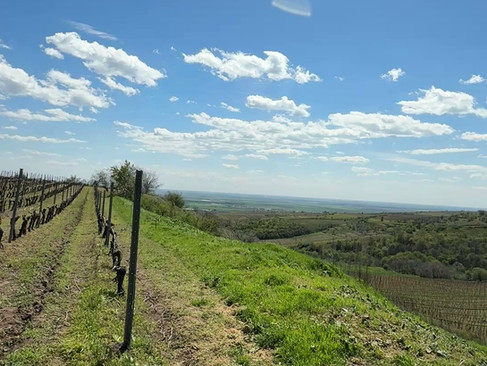
Then we went into the vineyards in Dealu Mare, and the scale stretched even further. The vineyard was windy, open, and vast. The rows moved up and down the hills in long, organized lines that made the land feel alive with structure. It was the kind of view that makes you stop talking for a second. Not because it is quiet exactly, but because it is big enough to remind you that wine is not small work.
This was only one of SERVE’s vineyard locations, and that point stuck with me. Looking across the hills, knowing this was part of a larger operation, it became easier to understand the human effort behind the wines. These vines do not take care of themselves. They are hand-cut and maintained by people who know the land, know the timing, and understand that every pass through the vineyard matters.
It takes a village to make wine at this scale. Not as a cute saying, but as an actual operating model.
That is one of the things that often gets lost when wine is reduced to tasting notes. We talk about cherry, plum, herbs, minerality, acidity, and finish. All of that matters. But standing in a vineyard like this reminds you that every bottle is also the result of labor. It is people pruning vine after vine, row after row, hill after hill. It is teams making decisions in weather that does not care about your production schedule. It is patience, repetition, and experience.
The vines themselves had personality. Some were twisted and rugged, with trunks that looked as if they held stories. Up close, they did not look delicate. They looked stubborn. They looked like they had earned their place in the ground. There was something fitting about that. Romanian wine, at least from what I experienced on this trip, has that same quality. It does not need to shout to prove itself, but it does need people to slow down long enough to understand it.
The Cellar Has a Soundtrack

Inside the winery, the tone shifted from wind and hills to barrels and sound. One of the most memorable details from the visit was the music. Classical music plays in the fermentation and barrel-aging space 24 hours a day, seven days a week. The idea is that the sound and vibrations help create subtle movement in the wine, almost like a gentle stirring effect. I am not going to pretend I walked out ready to defend the science of classical music and barrel aging in a doctoral thesis. But as a detail, it felt perfectly SERVE. Traditional, slightly unexpected, a little romantic, and just unusual enough to stay with you. Also, I still want to know if they have a punk rock day planned. Not for the premium barrels, maybe. But for science.
The best winery visits are not only about what you taste. They are about what you remember.
That little detail is where SERVE becomes more than just a historical winery. It has character. It is serious, but not stiff. It respects process, but there is room for curiosity.
Where Romance Meets Science

The lab brought the visit back to the practical side of winemaking. There is a feeling to wine, but there is also a science to it. The lab was a reminder that quality does not happen because people hope hard enough. It has to be measured, tracked, tested, and verified.
Behind every story about place and heritage, there is acidity, stability, alcohol, sugar, cleanliness, consistency, and quality control. That balance is one of the things I appreciated most about SERVE. The winery did not feel like it was leaning only on romance. It had the views, the history, the barrels, and the stories, but it also had the systems. That combination matters, especially when you are looking at a winery through an importer’s eyes.
The Importer’s Eye

The warehouse made that point even stronger. For most visitors, a warehouse full of cases and pallets might not be the most exciting part of a winery tour. For me, it was one of the most interesting. When you work around wine importing and distribution, the back end matters. A great story is important. A strong wine is important. But the ability to organize, pack, stage, ship, and support product movement determines whether a winery can operate beyond its tasting room. SERVE seemed comfortable in that reality. They spoke clearly about logistics, including that mixing pallets was not an issue. That might sound like a small detail, but for importers and distributors, it is not small. It suggests flexibility. It suggests experience. It suggests that the winery understands the business side of getting wine into other markets.
They also talked about their commitment to climate and environmental responsibility in a practical way. Not the overly polished, buzzword-heavy version. More like, “we do not keep lights on when we do not need to, and we cool only when cooling is needed.” That kind of operational discipline stood out to me.
A wine story has to survive the warehouse, the pallet, the container, the paperwork, and the shelf. SERVE seemed to understand that.
For a private operation, they seemed very well-versed. That may stem from team members having experience elsewhere, or it may simply reflect the modernization underway in Romanian wine. Either way, it made SERVE feel like a winery with both story and infrastructure. That matters if Romanian wine is going to grow in markets like the United States.
At the Tasting Table

The tasting itself was interesting: the wines were good, but none were personally unforgettable. That is not a knock. In fact, it made the visit feel more honest.
Not every bottle has to be life-changing to be meaningful. What stood out most was how each wine carried a story and how the domestic grape varieties gave the portfolio its strongest sense of place.
The Fetească Neagră and Fetească Albă variations were especially important to the experience. They gave the wines a Romanian identity, while the French-inspired approach brought a sense of polish and structure. That is the lane where SERVE became most compelling to me. Not in trying to compete with France, Italy, or Spain on their terms, but in showing what Romanian grapes can do when handled with intention. For readers who want to explore SERVE’s portfolio more directly, the winery’s Terra Romana and Cuvée ranges are useful starting points. They show how SERVE brings together local identity, international structure, and a more polished cellar style.
The Education Gap Is the Opportunity
For many U.S. consumers, Romanian wine is still unfamiliar. Even the grape names can be a hurdle. People are comfortable ordering Chardonnay, Cabernet Sauvignon, Pinot Noir, Sauvignon Blanc, or Merlot because those names already live in their memory. Fetească Neagră and Fetească Albă ask the drinker to learn something new before the bottle is even opened. That is not a weakness. It is an opportunity. The wines can work in the U.S. market, especially because some of them have a slightly softer, fruit-forward, and approachable profile that could resonate with American palates. But the story has to travel with the bottle. You cannot just place these wines on a shelf and expect the average buyer to know what to do. There has to be a bridge. That bridge is education. Not the boring kind. Not a lecture. More like an invitation:
Try this. Here is why it matters. Here is what it reminds you of. Here is what makes it different.
That is where SERVE feels like a strong standard-bearer for Romanian wine. It gives people an entry point. There is history for those who care about the country’s wine evolution. There is a French influence for those who want something familiar. There are domestic grapes for those looking to explore. There is enough polish to make the wines accessible, and enough Romanian character to make them worth talking about.
Part of a Bigger Romanian Wine Journey
This SERVE visit was part of the Wine Pleasures International B2B Workshop Romania, which brought together wine producers, buyers, and industry professionals for tastings, site visits, and market conversations. That setting mattered. Visiting a winery as part of a larger wine trade experience changes how you see the place. You are not only looking for a beautiful view or a good glass. You are looking for the story, the operation, the market fit, and the reason someone else should care. SERVE gave us all of that.
Why SERVE Stayed With Me


By the end of the visit, SERVE felt less like a single winery stop and more like a useful lens for understanding Romania’s wine potential. The yellow building gave the visit personality. The vineyards gave it scale. The hard work gave it humanity. The music gave it charm. The lab gave it discipline. The warehouse gave it commercial seriousness. The wines gave it a voice. And that voice is not trying to be anyone else. Romanian wine has its own flair, and it deserves to be appreciated on its own terms. SERVE is one of the wineries that can help people get there. It has enough familiarity to welcome new drinkers, but enough character to show them that Romania is not just another “emerging” wine region waiting to be compared to others. It is already itself. It is a starting point for understanding what Romanian wine can be. You just have to be willing to follow the yellow building, step into the wind, walk the rows, listen to the barrels, and let the story catch up to the glass.


Thank you, Christopher, for such a thoughtful and vivid portrayal of SERVE Winery and its role within Romania’s evolving wine identity. At Wine Pleasures, we truly appreciate the depth of your visit and the way you captured not only the wines, but the full ecosystem behind them — from vineyard to logistics, from history to innovation. Your reflections perfectly echo what we aim to showcase through the Wine Pleasures International B2B Workshop in Romania and also in Spain (coming up in October 2026): authentic stories, real people, and wineries that combine character with commercial readiness. SERVE is indeed a benchmark example of how Romanian wine can express both local identity and international understanding — and your article highlights exactly why this…